Skip to product information
1 of 13

Forage

Item 25-710

Item 25-710

Regular price $35.00 AUD
Regular price Sale price $35.00 AUD
Sale Sold out
Tax included.

Yes — these are quite interesting pieces of French industrial textile history, rather than ordinary agricultural sacks.

The mark reads “PEÑARROYA – CHILLED SHOT – FRANCE”. They were packaging for lead shot (grenaille de plomb) produced by the Société Minière et Métallurgique de Peñarroya, one of France’s major lead and zinc companies. Peñarroya acquired the large Noyelles-Godault works in northern France in 1920. In 1924 it erected a remarkable 60-metre shot tower specifically for manufacturing lead shot for hunting cartridges.

What does “Chilled Shot” mean?

“Chilled shot” isn't referring simply to the sacks having been refrigerated. It describes a type of hardened lead shot.

Traditionally, molten lead was poured through calibrated sieves at the top of a very tall shot tower. As the droplets fell, surface tension made them spherical and they partially solidified before landing in water at the bottom. Antimony and sometimes arsenic were added to make the lead harder; the finished pellets were subsequently sorted and often treated with graphite.

The resulting little spheres were principally intended for shotgun cartridges, particularly hunting ammunition.

Your wonderfully graphic logo therefore makes perfect sense: the bird within the diamond is almost certainly a game bird, advertising the intended use of the contents.

The numbers

The large 3, 4, 5 and 6 printed or stamped beneath the logo appear to be shot sizes rather than sack identification numbers. Your close-up, for example, shows:

PEÑARROYA
CHILLED SHOT
FRANCE
6

with what appears to be an additional weight/quantity marking beneath.

That's particularly nice because a group containing several numbers tells the story of the product much better than a single sack.

How old are they?

I would place your examples broadly around c.1940s–1960s, with the 1950s being a very plausible working date.

The Peñarroya shot works existed much earlier—the Noyelles-Godault shot tower was built in 1924—but the strong, relatively modern sans-serif typography and the style of the printed trademark look more mid-century to me than 1920s. The company was certainly producing shot in this period: the Noyelles-Godault works had returned to pre-war production levels by 1949 and subsequently became one of Europe's largest lead and zinc works.

Interestingly, another group of virtually the same Peñarroya Chilled Shot France sacks has recently been described in France as dating from the 1950s–60s, which supports that dating, although seller dating should always be treated cautiously.

And the fabric is interesting too

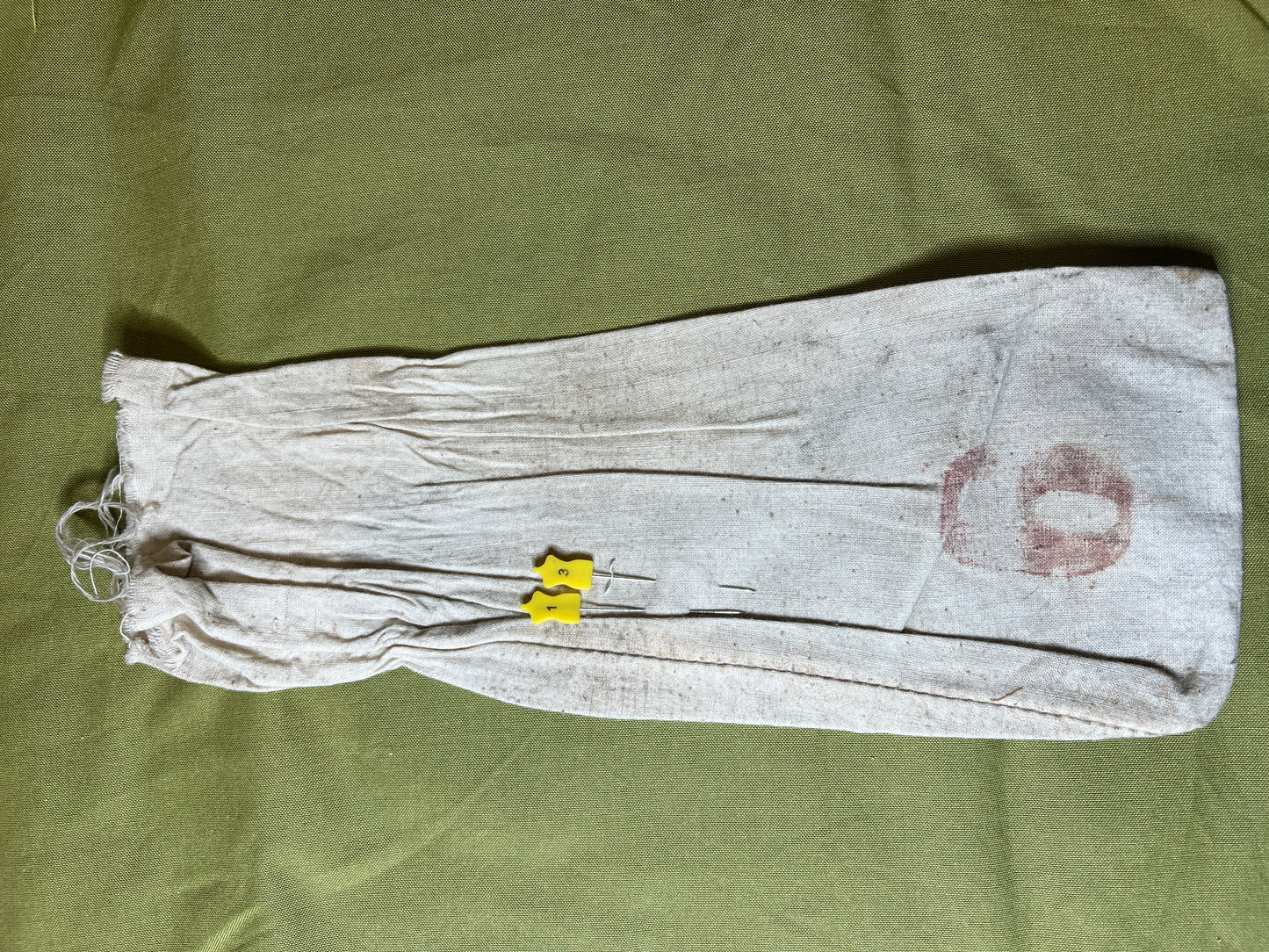
From your photographs, these appear to be closely woven cream cotton industrial cloth, rather than the coarse hessian/jute usually associated with sacks. That makes sense for lead shot: the pellets are small and extremely heavy, so the packaging needed to be dense, tough and securely stitched.

I particularly like the worn examples. The faded black printing, staining, creasing, repairs and traces of handling are all part of their industrial character. For textile collectors, the Peñarroya bird emblem is much more appealing than an anonymous sack.

There is also a nice connection between these little cloth bags and a now-lost piece of French industrial architecture: the Peñarroya shot tower at Noyelles-Godault was eventually demolished in 2006, after the works had become Metaleurop Nord.

One caution if you are selling or repurposing them: because they originally held lead shot, I would regard them as decorative/collectible textiles rather than recommend them for food storage, children's projects or anything involving prolonged skin contact unless they have been tested for residual lead contamination.

For a Forage flea-market context, I'd describe these as “c.1950s French Peñarroya Chilled Shot cotton sacks – original lead-shot/hunting cartridge packaging”. The strong typography and bird trademark make them particularly good pieces for slow stitching, assemblage or display—subject to the lead-residue caveat above.

View full details